C-Section in Berlin: What to Expect (Complete Guide for Parents)

Updated: Jul 2

I won’t go into the risks/benefits of a cesarean versus a vaginal birth (in case of cesarians that are elective; I cover some aspects of that in more detail in my article on elective C-sections).
In this article, I’ll walk you through how you can prepare both emotionally and practically for a planned cesarean birth.
Whether your cesarean is medically needed or a personal choice, this guide is here to help you feel informed, and as prepared as possible. We’ll explore what you can do before, during, and after the birth to approach this experience with more confidence.
This is based on my experience as a doula supporting births in Berlin, as well as my understanding of current practices and guidelines in Germany.
Seeing Your C-section As A Birth, Rather Than A Surgery
Yes of course, a c-section is a major abdominal surgery, but I want to highlight that it remains a birth. And there are ways that you can prepare yourself to make it feel like this, as a truly transformative and positive life transition.
Because images speak louder than words, I wanted to share this beautiful VIDEO
The content is graphic from 2m30 to about 2m50 because you can see that the baby has blood on her body (blood from the mother, which is expected and normal), but you will not see the surgery in itself in this video.

What To Expect During The Procedure Of A Planned C-Section in Berlin?
Your planned C-section (called a Sectio) highly organized, routine procedure of about 30-45-minute
How the room is set up
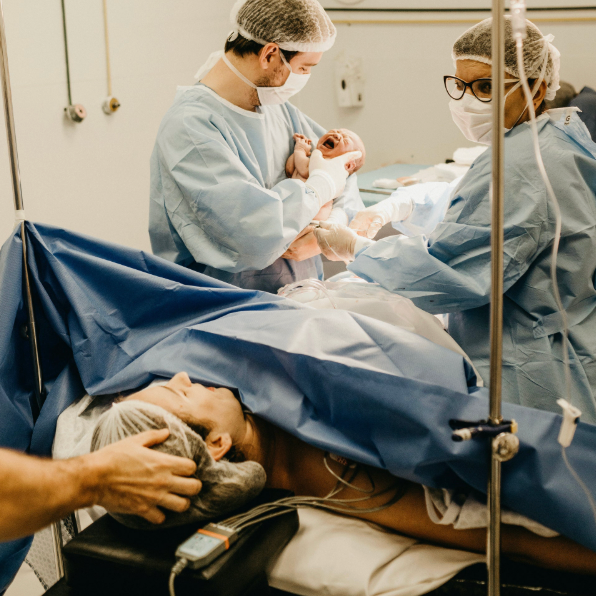
A sterile drape is hung at your chest. You won't see the surgery (unless you ask for the drape to be lowered), but your partner sits by your head to support you.
You will be surrounded by machines (which are monitoring you, your baby, or are used by the staff.) There is quite a bit of noise (for example when your amniotic fluid is aspirated), and even smells (when the belly cavity is opened, or when cauterisation is used to close blood vessels ...)
You may have your arms attached to the bed (one or both), in a Christ position to prevent you from falling off the table.
You’ll be surrounded (usually) by two surgeons, an anesthesiologist, a midwife (Hebamme), and often pediatric nurse to take care of the baby if needed.
What Happens (Standard Procedure Without Complications)
Numbing: You receive a spinal anesthetic; you are awake but numb from the chest down. It is usually an epidural or spinal. That means something will be injected at the bottom of your back.
The Delivery: The baby is born within a few minutes following the incision. You will feel pressure and "tugging," it can be really strong, they have to get the baby out of the womb and pelvis. You feel movements but no pain.
Skin-to-Skin: I have seen that in a few clinics Berlin, they paid a lot of attention to bonding, This is great,, as you will read below the first contact is important for mother and baby. So, if the baby is healthy, they are placed directly on your chest while the surgeons finish the procedure.
Closing: The surgeons spend the remaining 30 minutes closing the incision with dissolvable stitches.
After Birth: If everyone is well, when the procedure is over you go to a delivery room or recovery room for observation during 2-3 hours. Ideally, your baby is skin to skin with you and get their first feed. Before going to your room in the after birth station, your baby will be examined and dressed.
Of course if you or baby need extra medical attention, you may be separated for a time and even geographically separated if your baby needs to be transferred to a clinic with a NICU for example.

What Type of C-Section Will You Go For? There Are Multiple Ways To Birth Via C-Section
Did you even know that there are different types of C-sections?
The intervention itself can look different from a surgeon/team/place to an other. Hence I believe that it is important that you know the main options and discuss with different providers about what they can offer so that you can make an informed choice about what you get and hence, where you go.
In Berlin, the most common technique is the Misgav-Ladach method, often called a sanfter Kaiserschnitt (gentle cesarean). This is the standard approach in many hospitals. It’s designed to be less invasive, using more gentle separation of the tissues (using fingers instead of a scalpel), so tearing tissues instead of cutting, which can help support an easier recovery. You can also often ask the team to be quiet, put the lights down when baby comes down, and lower the drape for you to see baby come out. Make sure you talk about this in advance.
You might also hear about something called a Kaisergeburt (family-centered cesarean). This is less about the surgical technique and more about how you experience the birth. In practice, this means that during the moment of birth, things are adapted to feel a little more like a birth: the drape that usually separates you from the surgical field can be lowered for a few minutes once the uterus is opened. The lights may be dimmed, and the baby is brought out slowly.
Instead of the baby being lifted out quickly, the birth can unfold gradually, mimicking a bit a vaginal birth.
For many parents, this can make the experience feel much more emotional, connected, and real. Charite offers this but they are not the only ones in Berlin

There are also other, less common approaches. One of them is the extraperitoneal cesarean, sometimes called the “French C-section.” This technique avoids opening the abdominal cavity, which may help reduce pain and support a quicker recovery. It’s still quite new in Germany and not widely available yet, but some places like Sana Klinikum Lichtenberg, are starting to offer it.
In the “maternal-assisted cesarean”, under very controlled and sterile conditions, the mother may reach down and help guide the baby out.
This approach is still quite rare and not widely practiced, especially in Germany.
If this speaks to you, it’s absolutely worth opening the conversation with your care team. The more parents express these wishes, the more space we create for practices to evolve. Have a look at this video here if you are interested to see how this works!
Feeling Prepared: Practically & Emotionally
A planned cesarean gives you something very special: time to prepare. Not just practically, but emotionally, too.
Taking a moment to slow down and connect with yourself before the birth can make a real difference in how you experience it. This is an invitation to reflect, and prepare for the moment you will meet your baby.
You might want to start by asking yourself a few simple questions:
Questions to ask yourself before your C-section in Berlin
What am I feeling right now about this cesarean birth?
(fears, hopes, past experiences, expectations…)
What helps me feel calm and grounded when I’m nervous?
Who do I want to have with me on the day of the birth?
How can my partner or support person support me emotionally before, during, and after?
Is there something I would like to do before the birth to mark this moment as a rite of passage?
Do I have what I need for the postpartum period so I can focus on rest and recovery?
Ask your provider what they think about colostrum harvesting in your case (follow the link to other article on c-section which explains it)
Here are some ideas you can explore in the days leading up to your birth, to create meaningful moments.
Gently massage your belly and talk to your baby; share what’s coming, and how you feel
Write a letter to your baby, or to yourself in this moment
Light a candle or take a few minutes of silence to connect inward
Take a warm bath with calming scents like lavender, rose, or chamomile
Listen to a guided meditation and visualize your cesarean birth in a calm and positive way (contact me I can share a few with you, happy to ;) )
Prepare a playlist of music that makes you feel safe and supported
etc.
These small rituals can help you feel more connected, more grounded, and more emotionally prepared for the experience.
As a doula, I support clients preparing for their c-section births. You can get in touch if you are interested in this companionship. Or even just a one-off session to talk about your questions and emotions.
Questions to ask your provider before your C-section in Berlin
It may be helpful to ask your provider these questions during a prenatal visit:
What happens if I naturally get into labour before my planned c-section date? Or if I need it ahead of the planned date?
What will the timeline of the day look like?
How long before the surgery can I eat or drink?
Can I walk in the OP room or do I need to wheeled in?
Can I have the urinary catheter placed once I am numbed (rather than before)?
When is my partner able to be with me?
Will someone explain things to me step by step during the process?
How common is it to use instruments delivery for a planned c section/ or fundal pressure?
Can we play our own music during the birth? Can photos be taken?
Is delayed cord clamping possible for my baby?
If baby needs extra care, how will that be communicated to us?
Is it possible to have skin-to-skin care with my baby in the operating room? What are the conditions? Do you provide a bonding top?
Are parents and babies able to do their post-op recovery in the same room?
For breech or transverse babies: What can I expect in terms of process and manoeuvres to get my baby out safely? Where will my scar be located and how long can I expect it to be?
During the Intervention: The “Little Things” That Can Make a Big Difference
Even within a cesarean birth, there are many small things that can really elements that you can "control" to support a positive experience.
In most hospitals in Berlin, your partner can be with you (not throughout but when the cavity is opened and the baby pulled out usually). You can also ask to play music that helps you feel calm and safe. Some parents like to ask the team to keep the atmosphere quiet and focused, without too much unrelated conversation, so they can stay in their own “bubble.”

Here are other ideas for you to transform this moment:
Sing to accompany your baby coming out, play music, and center yourself in your heart space.
Visualize your loved ones by your side, holding you
Visualize a bubble of love surrounding your baby: the baby leaves the womb in this pocket of loving energy and stays there as long as needed.
Speak to your baby (out loud or innerly), guiding them gently through their transition between two worlds: aquatic and air.
Say a welcome message for your baby’s arrival, fully connecting to the present moment.
You can also talk about whether it’s possible to lower the drape so you can see your baby being born. Another important point is delayed cord clamping, waiting a little before cutting the cord so your baby can receive more blood from the placenta. This isn’t always possible, but it’s definitely worth asking about in advance.

Skin-to-Skin: A Powerful First Connection
Skin-to-skin is a natural process that involves placing a naked newborn on their parent’s bare chest and covering the infant with blankets to keep them dry and warm.
Research demonstrates that both immediate and very early skin-to-skin care after a Cesarean is safe and beneficial for the mother/baby and breastfeeding journey.
Many clinics in Berlin allow you to do skin to skin directly after the baby is extracted, if baby is well, and continuously. This is a topic to cover during the prenatal appointment.
Vaginal Seeding?
Microbiome seeding – also called vaginal seeding – is the practice of wiping a caesarean-born baby’s mouth, face and/or skin with a cloth that has been in or near its mother’s vagina just prior to the caesarean.
While small studies show this support better gut health for the baby there are also potential risk of transferring harmful, asymptomatic infections to the newborn.
You may inform yourself to form your own opinion and discuss this practice with the medical staff. An article from midwife Sarah Wickham that I found interesting.
Keep in mind that early skin-to-skin and breastfeeding are highly evidence-based practices that support baby's microbiome development after a C-section.
Preparing for the Postpartum: Thinking About “After”
Taking time before the birth to reflect on this phase can help you feel more supported, more aligned as a couple, and more prepared for the reality of life with a newborn.
Here are some questions you can explore together:
What can I expect about my body and recovery, realistically?
How can we maximise my chances to recover physically from this c-section (rest, nourishment, space to be heard...)
What is worrying me about postpartum; and how could we plan around it to make things easier?
What will daily life look like once my partner or main support person goes back to work?
How do I imagine a typical day or week with a newborn? And how flexible can I be with that vision?
What are my expectations of you (as my partner/support person) in the first days, weeks, and months?
What do we expect from our baby in terms of sleep; and how does that compare with real newborn sleep patterns?
Some ideas of rituals help you process your experience and reconnect with your body.
Here are a few ideas:
Gently care for your scar over time: touch it, massage it (ask your midwife for advice), and slowly reconnect with this part of your body
Take a photo of your baby next to your cesarean scar
Talk about your birth experience, or write it down
Healing after a cesarean takes patience. Rückbildung (postpartum recovery exercises) is an important step to help your body regain strength.
Your midwife can also guide you on how to care for your scar and, when the time is right, how to massage it to help prevent adhesions and support long-term comfort.
In some cases you may be entitled to postpartum support paid by the health insurance. Someone could come over at home to support you and your household. This is called Haushalthilfe. Enquire for this in advance to get help from day 1!
The support is prescribed by a doctor and approved by the health insurance company. You may be eligible for a Haushaltshilfe (home support covered by health insurance) if, after birth, you are temporarily unable to manage daily household tasks and childcare on your own (for physical or mental health reasons etc.)
Ask your doctor or gynecologist for a prescription (Verordnung für Haushaltshilfe).
Send it to your health insurance (Krankenkasse).
The insurance reviews the request.
If approved, a helper can come to your home for a certain number of hours or days.
Look for helpers: Search online: “Mütterpflegerin/Haushalthilfe + your city”. You can alo ask your Hebamme (midwife) — they often know local providers.
Offer yourself (and baby) nurturing care:
As a doula I offer postpartum massages specifically for C-section Mamas, to be done minimum 6 weeks after birth.
I also created a closing ceremony to help you process your birth and come to closure with body and mind.

Taking Care of Yourself and Your Little One Right After Birth
After surgery, you will initially remain numb, but as the anesthesia wears off, you will begin to feel discomfort. Managing your pain is very important...
While medical staff often provide standard doses of paracetamol or ibuprofen, this is not sufficient for everyone. And this is where it's important you advocate for yourself
Do not wait for the pain to become unbearable. Discuss your pain frequently with the staff.
If standard medication isn't enough, ask about dosage adjustments or stronger alternatives. You have undergone major surgery and deserve adequate relief!
If you find it difficult to speak up, ask your partner or a support person to advocate for you
Rooming and Hospital Logistics in Berlin After A C-Section
The environment in these first few days plays a significant role in your mental and physical state... Berlin's postpartum station are often very busy during days and nights. Multiple people enter te room (nurses, midwives, paediatricians, gynecologists, cleaners, catering staff, and of course visitors for you/the people sharing the room with you.)
It can be very overwhelming when you are trying to recover and bond with your baby. A lot of families I accompany are shocked by this reality. This is why I rather describe it to manage your expectations
You usually have:
Family Room (Familienzimmer): are private rooms that include an extra bed for a partner. Because they usually cannot be booked in advance and are offered on a first-come, first-served basis, keep your expectations realistic. Ask about availability immediately upon arrival and keep asking for one, but be prepared that you may not get one.
Shared room: If no family room is available, be prepared to share a room with other mums. And know that in shared rooms, support persons are typically restricted to official visiting hours and cannot stay overnight.

If you are in a shared room without a partner overnight, you will rely more heavily on hospital staff to help you with baby. Because yes, after this major surgery you will most likely be limited in your movements and capacity to care alone for your baby. Many women can stand/walk about 24 hours post surgery, but this can still be painful and you need to do things at your rhythm... holding a baby, standing in front of a changing table, showering, going to the toilet... are little things that require strength and energy!
While in the hospital, you can ask the nurse for a sign to put on your door several times a day to tell visitors that you are resting so that they can delay non urgent routine questions/care when you sleep.

Preparing For Your C-Section Postpartum
If possible, ask to see a typical room before your surgery date to familiarize yourself
Pack items that make the space feel like home, such as your favorite blanket, a supportive nursing pillow, your toiletries etc.
Hospital food can be hit-or-miss. You can coordinate with friends or family to have freshly cooked meals brought to you.
A bonding top or skin-to-skin wrap is an excellent addition to your bag. It allows you to keep your baby close while keeping your hands free, which is especially helpful when you are recovering from surgery.
Know that there will be big emotions... and you are allowed to feel elated, down, sad, happy, all at the same time. I find writing a journal useful during these transformational times. But also opening up to people who love you and can listen without judgment.
It is important for your loved ones to realize that you need time to recover from childbirth and surgery and to learn to (breast)feed your baby. You are allowed to set boundaries for you and your baby and decline visitors for example, or ask for help!
In the early weeks after arriving home, feel free to ask for and accept help from family and friends. They want to help, so ask them to do some of the usual household chores or bring prepared, healthy food. Continue to drink to thirst and eat nutritious foods to help regain your strength. Prioritising your wellbeing is very important for your start into motherhood. You deserve care too! As a postpartum doula I support my clients in the clinic or at home for a smooth postpartum experience.
A Note on Breastfeeding After a Cesarean
One thing that can be really helpful to prepare before the birth is learning about breastfeeding after a cesarean. I offer a 1-1 preparation for breastfeeding, in person, and can tailor it to you (see "breastfeeding 101")!
You may also ask your provider what they think about colostrum harvesting in your case (follow the link to other article on c-section which explains it)
Because of the incision and the initial discomfort, some positions can feel better than others (for example, side-lying or the “football hold,” which keeps pressure away from your belly).
Having a bit of knowledge in advance can make a difference in helping feeding get off to a good start.
Breastfeeding should be comfortable. Learning a new skill often takes time, no matter how your baby arrived! If for any reason breastfeeding is not going smoothly or you find it painful to breastfeed, ask your midwife or a lactation consultant for advice asap.
The earliest you troubleshoot, the easier it will be.


Comments